
QwenLM/qwen-code
 [
[


An open-source AI agent that lives in your terminal.
中文 | Deutsch | français | 日本語 | Русский | Português (Brasil)
🎉 News (2026-02-16): Qwen3.5-Plus is now live! Sign in via Qwen OAuth to use it directly, or get an API key from Alibaba Cloud ModelStudio to access it through the OpenAI-compatible API.
Qwen Code is an open-source AI agent for the terminal, optimized for Qwen3-Coder. It helps you understand large codebases, automate tedious work, and ship faster.
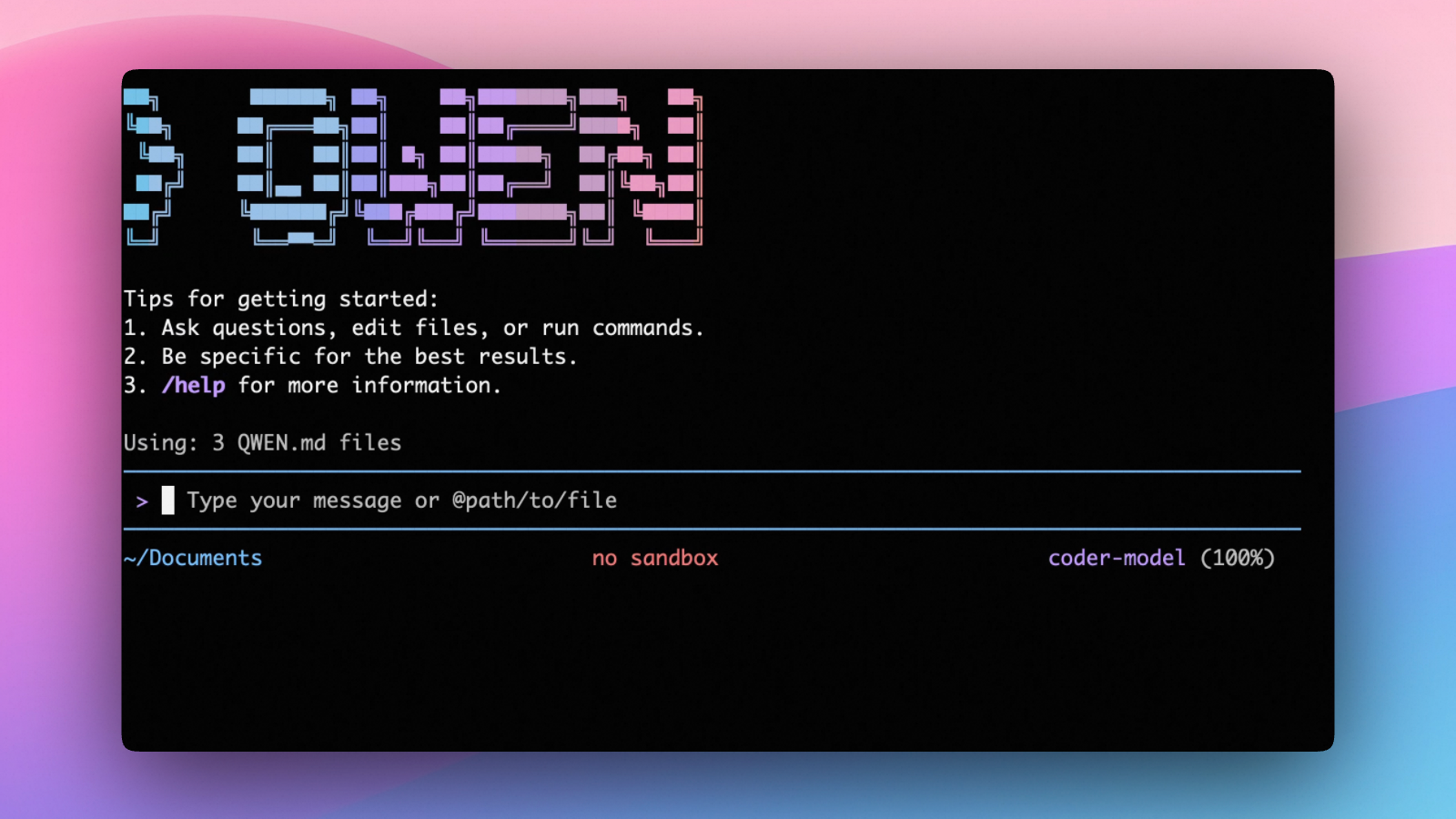
Why Qwen Code?
- Multi-protocol, OAuth free tier: use OpenAI / Anthropic / Gemini-compatible APIs, or sign in with Qwen OAuth for 1,000 free requests/day.
- Open-source, co-evolving: both the framework and the Qwen3-Coder model are open-source—and they ship and evolve together.
- Agentic workflow, feature-rich: rich built-in tools (Skills, SubAgents) for a full agentic workflow and a Claude Code-like experience.
- Terminal-first, IDE-friendly: built for developers who live in the command line, with optional integration for VS Code, Zed, and JetBrains IDEs.
Installation
Quick Install (Recommended)
Linux / macOS
|
|
Windows (Run as Administrator CMD)
|
|
Note: It’s recommended to restart your terminal after installation to ensure environment variables take effect.
Manual Installation
Prerequisites
Make sure you have Node.js 20 or later installed. Download it from nodejs.org.
NPM
|
|
Homebrew (macOS, Linux)
|
|
Quick Start
|
|
On first use, you’ll be prompted to sign in. You can run /auth anytime to switch authentication methods.
Example prompts:
|
|
Click to watch a demo video
Authentication
Qwen Code supports two authentication methods:
- Qwen OAuth (recommended & free): sign in with your
qwen.aiaccount in a browser. - API-KEY: use an API key to connect to any supported provider (OpenAI, Anthropic, Google GenAI, Alibaba Cloud Bailian, and other compatible endpoints).
Qwen OAuth (recommended)
Start qwen, then run:
|
|
Choose Qwen OAuth and complete the browser flow. Your credentials are cached locally so you usually won’t need to log in again.
Note: In non-interactive or headless environments (e.g., CI, SSH, containers), you typically cannot complete the OAuth browser login flow. In these cases, please use the API-KEY authentication method.
API-KEY (flexible)
Use this if you want more flexibility over which provider and model to use. Supports multiple protocols:
- OpenAI-compatible: Alibaba Cloud Bailian, ModelScope, OpenAI, OpenRouter, and other OpenAI-compatible providers
- Anthropic: Claude models
- Google GenAI: Gemini models
The recommended way to configure models and providers is by editing ~/.qwen/settings.json (create it if it doesn’t exist). This file lets you define all available models, API keys, and default settings in one place.
Quick Setup in 3 Steps
Step 1: Create or edit ~/.qwen/settings.json
Here is a complete example:
|
|
Step 2: Understand each field
| Field | What it does |
|---|---|
modelProviders |
Declares which models are available and how to connect to them. Keys like openai, anthropic, gemini represent the API protocol. |
modelProviders[].id |
The model ID sent to the API (e.g. qwen3-coder-plus, gpt-4o). |
modelProviders[].envKey |
The name of the environment variable that holds your API key. |
modelProviders[].baseUrl |
The API endpoint URL (required for non-default endpoints). |
env |
A fallback place to store API keys (lowest priority; prefer .env files or export for sensitive keys). |
security.auth.selectedType |
The protocol to use on startup (openai, anthropic, gemini, vertex-ai). |
model.name |
The default model to use when Qwen Code starts. |
Step 3: Start Qwen Code — your configuration takes effect automatically:
|
|
Use the /model command at any time to switch between all configured models.
More Examples
Coding Plan (Alibaba Cloud Bailian) — fixed monthly fee, higher quotas
|
|
Subscribe to the Coding Plan and get your API key at Alibaba Cloud Bailian.
Multiple providers (OpenAI + Anthropic + Gemini)
|
|
Enable thinking mode (for supported models like qwen3.5-plus)
|
|
Tip: You can also set API keys via
exportin your shell or.envfiles, which take higher priority thansettings.json→env. See the authentication guide for full details.
Security note: Never commit API keys to version control. The
~/.qwen/settings.jsonfile is in your home directory and should stay private.
Usage
As an open-source terminal agent, you can use Qwen Code in four primary ways:
- Interactive mode (terminal UI)
- Headless mode (scripts, CI)
- IDE integration (VS Code, Zed)
- TypeScript SDK
Interactive mode
|
|
Run qwen in your project folder to launch the interactive terminal UI. Use @ to reference local files (for example @src/main.ts).
Headless mode
|
|
Use -p to run Qwen Code without the interactive UI—ideal for scripts, automation, and CI/CD. Learn more: Headless mode.
IDE integration
Use Qwen Code inside your editor (VS Code, Zed, and JetBrains IDEs):
TypeScript SDK
Build on top of Qwen Code with the TypeScript SDK:
Commands & Shortcuts
Session Commands
/help- Display available commands/clear- Clear conversation history/compress- Compress history to save tokens/stats- Show current session information/bug- Submit a bug report/exitor/quit- Exit Qwen Code
Keyboard Shortcuts
Ctrl+C- Cancel current operationCtrl+D- Exit (on empty line)Up/Down- Navigate command history
Learn more about Commands
Tip: In YOLO mode (
--yolo), vision switching happens automatically without prompts when images are detected. Learn more about Approval Mode
Configuration
Qwen Code can be configured via settings.json, environment variables, and CLI flags.
| File | Scope | Description |
|---|---|---|
~/.qwen/settings.json |
User (global) | Applies to all your Qwen Code sessions. Recommended for modelProviders and env. |
.qwen/settings.json |
Project | Applies only when running Qwen Code in this project. Overrides user settings. |
The most commonly used top-level fields in settings.json:
| Field | Description |
|---|---|
modelProviders |
Define available models per protocol (openai, anthropic, gemini, vertex-ai). |
env |
Fallback environment variables (e.g. API keys). Lower priority than shell export and .env files. |
security.auth.selectedType |
The protocol to use on startup (e.g. openai). |
model.name |
The default model to use when Qwen Code starts. |
See the Authentication section above for complete
settings.jsonexamples, and the settings reference for all available options.
Benchmark Results
Terminal-Bench Performance
| Agent | Model | Accuracy |
|---|---|---|
| Qwen Code | Qwen3-Coder-480A35 | 37.5% |
| Qwen Code | Qwen3-Coder-30BA3B | 31.3% |
Ecosystem
Looking for a graphical interface?
- AionUi A modern GUI for command-line AI tools including Qwen Code
- Gemini CLI Desktop A cross-platform desktop/web/mobile UI for Qwen Code
Troubleshooting
If you encounter issues, check the troubleshooting guide.
To report a bug from within the CLI, run /bug and include a short title and repro steps.
Connect with Us
- Discord: https://discord.gg/ycKBjdNd
- Dingtalk: https://qr.dingtalk.com/action/joingroup?code=v1,k1,+FX6Gf/ZDlTahTIRi8AEQhIaBlqykA0j+eBKKdhLeAE=&_dt_no_comment=1&origin=1
Acknowledgments
This project is based on Google Gemini CLI. We acknowledge and appreciate the excellent work of the Gemini CLI team. Our main contribution focuses on parser-level adaptations to better support Qwen-Coder models.